

Sales skills are not something a person either has or does not have. Most of them can be learned, practiced and improved through real conversations, feedback and repetition.
That is one of the reasons sales can be such a powerful profession for personal and professional development. A salesperson learns how to listen, ask better questions, communicate clearly, handle uncertainty, recover from rejection and take responsibility for their own results.
But being good at sales requires more than confidence or the ability to talk.
Strong salespeople know how to understand people, adapt to different situations and help customers make decisions that genuinely make sense for them.
So which sales skills matter most?
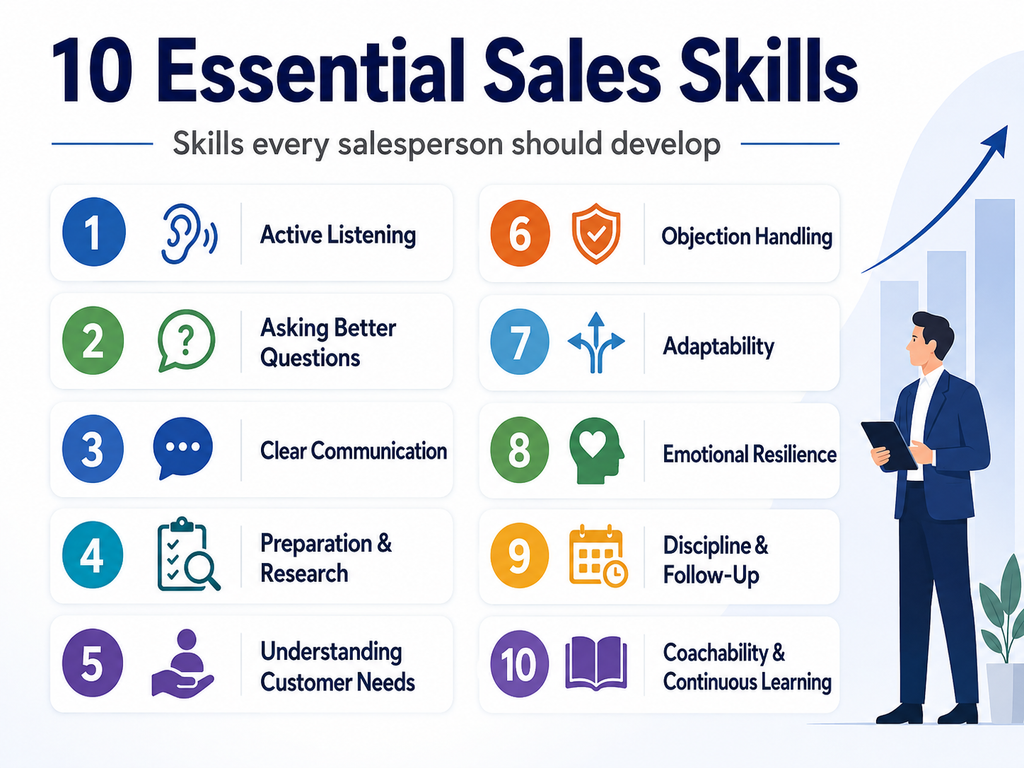
Sales skills are the abilities that help a salesperson move a customer conversation forward effectively – from the first contact and understanding the customer’s needs to presenting a solution, handling objections and agreeing on next steps.
Some are interpersonal skills, such as listening and communication. Others are more practical, such as preparation, follow-up and objection handling.
The strongest salespeople develop both.
At Southwestern Ventures, we work with salespeople across different industries and sales environments, including phone sales, face-to-face sales, B2B sales, fundraising and financial services. The exact sales process may change, but many of the core skills remain surprisingly consistent.
Here are ten of the most important.
One of the most important sales skills is also one of the easiest to underestimate.
Listening does not mean waiting quietly until it is your turn to speak. It means trying to understand what the customer is actually saying, what matters to them and what may be behind their answer.
A salesperson who listens well notices details that would otherwise be missed.
Instead of immediately jumping to a solution, they ask follow-up questions:
Listening gives the salesperson better information, but it also changes the quality of the conversation. Gong’s analysis of 326,000 sales calls found that strong sales conversations are not about dominating airtime, but about creating a balanced, interactive dialogue with meaningful buyer participation. People are more likely to speak openly when they feel that the other person is genuinely interested in understanding them.
This is the thinking behind the 70/30 rule in sales: the salesperson does not need to dominate the conversation to guide it effectively.

Good listening and good questions work together.
Weak sales conversations often follow a script regardless of what the customer says. Strong conversations develop based on the customer’s answers.
Instead of asking only factual questions, good salespeople learn to ask questions that help uncover priorities, problems and motivations.
For example:
Factual question:
“What solution are you currently using?”
Better follow-up:
“What works well with it, and what would you like to improve?”
Or:
Factual question:
“When would you like to make a decision?”
Better follow-up:
“What needs to happen before you would feel comfortable making that decision?”
The goal is not to interrogate the customer.
The goal is to understand enough of their situation that the recommendation you eventually make is relevant.
Good salespeople do not try to sound impressive. They try to make things clear.
That means explaining ideas in a way the customer can easily understand and connecting the solution to what the customer has already said matters to them.
Clear communication also means knowing what not to say.
Too much information can make a simple decision feel complicated. Long explanations can hide the point. Industry terminology can create distance rather than confidence.
A strong salesperson can take something complicated and explain it simply without making it inaccurate.
They also adapt their communication.
One customer may want detailed information and time to compare alternatives. Another may want the three most important points and a clear recommendation.
Good communication is not about having one perfect pitch. It is about making your message understandable to the person in front of you.
Great sales conversations often begin before the customer enters the room or answers the phone.
Preparation helps salespeople ask better questions and avoid wasting the customer’s time.
Depending on the type of sale, preparation can include:
Preparation does not mean planning every sentence in advance.
In fact, over-preparing a pitch can make a salesperson less flexible.
The purpose of preparation is to understand the context well enough that you can focus on the customer once the conversation starts.
There is an important difference between knowing what your product does and understanding why a particular customer might need it.
Product knowledge answers:
“What can we offer?”
Customer understanding answers:
“Why would this matter to this person?”
That distinction is central to good sales.
A feature that is extremely important to one customer may be irrelevant to another. A problem that seems small from the outside may be the customer’s biggest priority.
Strong salespeople therefore avoid presenting solutions too early.
They first understand the current situation, the desired outcome and the gap between the two.
Only then can they connect their solution to something the customer actually values.
Objections are a normal part of sales.
Price, timing, uncertainty, existing providers and the need to think are all common reasons customers hesitate.
One of the biggest mistakes salespeople make is responding to an objection before they understand it.
If a customer says:
“It is too expensive.”
the real concern could be several different things:
Those situations require different responses.
This is why we use frameworks such as the LAER method for handling sales objections:
Listen → Acknowledge → Explore → Respond
Instead of trying to defeat the objection, first understand it.
That is a much more transferable sales skill than memorising clever responses.
No two customers are exactly the same.
The salesperson who relies on one script, one communication style or one sales technique will eventually struggle when the situation changes.
Adaptability means being able to notice what is happening and adjust.
You may need to:
Adaptability has become even more important as customers gain access to more information before speaking with salespeople. Salesforce similarly highlights adaptability, customer understanding and a combination of human and data-driven skills as increasingly important for modern sales professionals.
The salesperson is no longer always the primary source of product information. Their value increasingly comes from helping the customer interpret information, understand trade-offs and make a good decision.
Rejection is part of sales.
A customer may say no even when you handled the conversation well. A deal can disappear after weeks of work. Some days produce great results and others do not.
The ability to recover matters.
Emotional resilience does not mean pretending that disappointment has no effect on you. It means learning how to process it without allowing one difficult conversation to determine the quality of the next ten.
A strong salesperson asks:
What can I learn from this?
instead of:
What is wrong with me?
Over time, this creates a healthier relationship with performance.
Confidence becomes less dependent on the result of one conversation and more connected to preparation, effort and continued improvement.
Sales rewards consistency.
Many important parts of the job are not particularly exciting:
But those small actions accumulate.
A salesperson with average natural ability and strong habits can often outperform someone with great potential but inconsistent execution.
This is why we believe sales habits matter more than talent.
Follow-up is a particularly important part of discipline.
A good sales conversation loses value quickly if the salesperson does not do what they promised afterward. Reliability builds trust just as much as communication does.
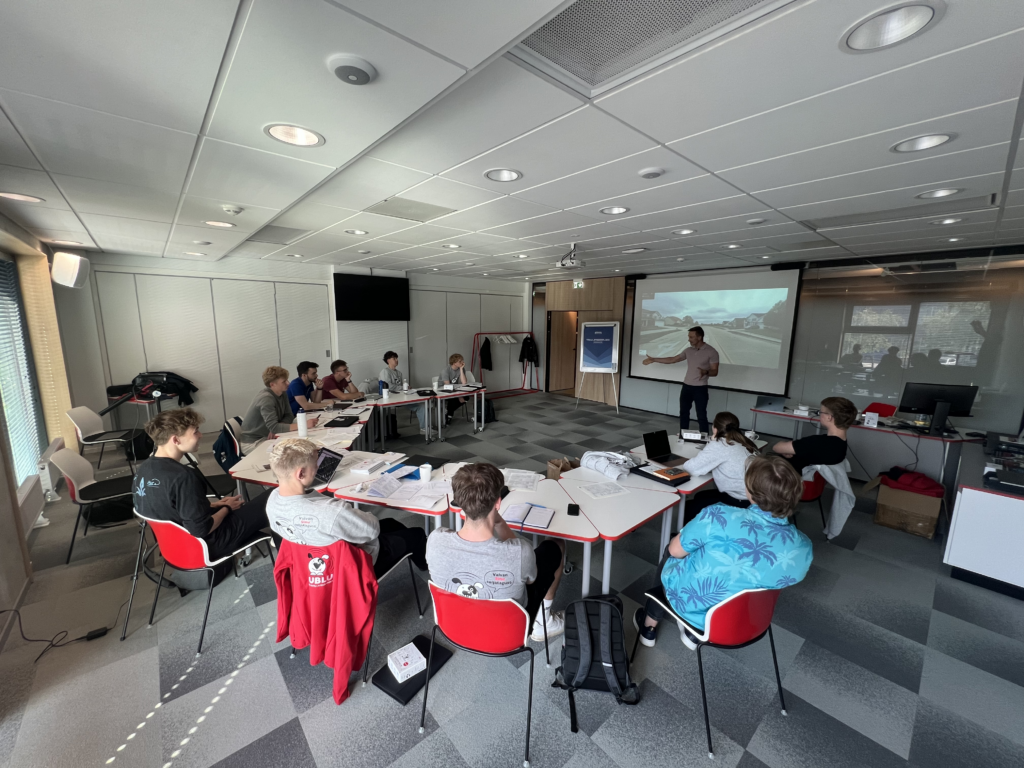
The final skill is the ability to improve the other nine.
Coachability means being willing to receive feedback, test a different approach and honestly evaluate your own performance.
Sales gives unusually fast feedback.
You have conversations every day. You hear objections. You see where customers lose interest. You notice which questions create better discussions and which explanations create confusion.
That creates a powerful learning environment – if you are willing to use it.
The fastest-growing salespeople do not treat feedback as criticism of who they are.
They treat it as information.
They ask:
Over hundreds of conversations, these small adjustments create a very different salesperson.
There is no single sales skill that works on its own.
Active listening without good questions only gets you so far. Product knowledge without communication skills can overwhelm the customer. Confidence without adaptability can become pushiness. Discipline without reflection can mean repeating the same mistakes consistently.
Strong sales performance comes from combining skills.
If you are new to sales, you do not need to master all ten at once.
Start with three fundamentals:
Those three habits create a strong foundation for almost everything else.
Reading about sales can help, but sales skills are ultimately developed through practice.
The fastest way to improve is to create a simple learning loop:
Have real conversations. Sales is difficult to learn only theoretically.
Think about what happened rather than judging the conversation only by whether you made the sale.
A coach, manager or experienced colleague can often see patterns that are difficult to notice yourself.
Instead of trying to “become better at sales,” choose something specific.
For example:
“This week I will focus on asking one additional follow-up question before presenting a solution.”
That is measurable and trainable.
One good conversation does not create a skill.
Repetition does.
At Southwestern Ventures, we see sales as much more than learning how to sell a particular product.
People who enter sales often develop skills that become valuable far beyond the sales role itself: communication, resilience, responsibility, leadership, self-awareness and the ability to work with different kinds of people.
That is also why sales can become such a strong starting point for a career.
You are put into situations where you need to communicate, think, adapt and improve continuously – and you receive feedback from the real world every day.
The strongest salespeople are not necessarily the loudest, most charismatic or most naturally confident people in the room.
They are often the people who stay curious, practice consistently and keep learning from every conversation.
If you want to develop these skills through real experience, coaching and daily practice, explore career opportunities at Southwestern Ventures.