

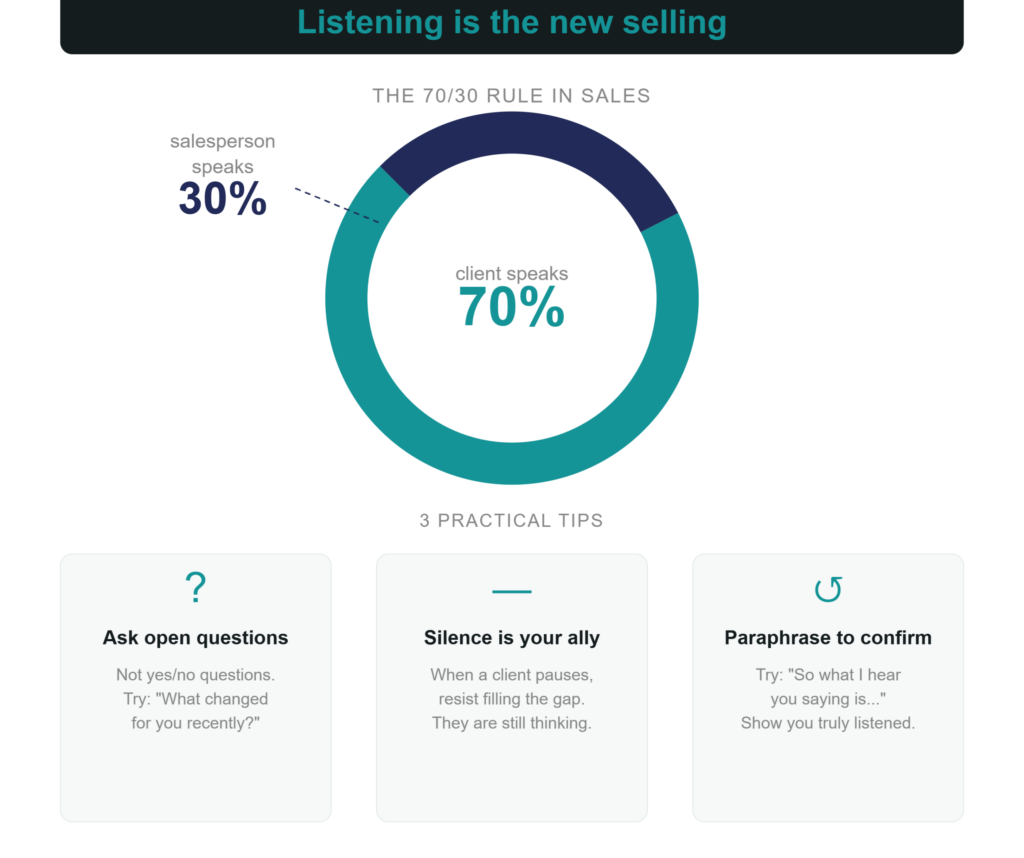
The 70/30 rule in sales is a simple guideline: let the prospect do roughly 70% of the talking while the salesperson uses their 30% to ask questions, clarify needs and guide the conversation.
But 70/30 should not be treated as a rigid formula. The right talk-to-listen ratio depends on the stage of the sales conversation. The bigger principle is simple: understand before you pitch.
The 70/30 rule is simple: during a sales conversation, the prospect should be doing 70% of the talking, and the salesperson should be doing only 30%.
That 30% is not wasted time. It is spent asking sharp, well-prepared questions that guide the conversation forward, clarifying what the prospect has said, and presenting solutions only once you truly understand the situation.
The 70/30 rule is commonly associated with the Sandler Sales methodology, which teaches that prospects should do most of the talking while salespeople focus on asking thoughtful questions and understanding their needs. Conversation data from Gong supports the broader value of listening, although its research does not suggest that 70/30 is a universal ideal ratio.
There is a reason so many salespeople dominate their own conversations. Sales training has historically focused on product knowledge, objection handling scripts, and closing techniques. All of these require the salesperson to talk.
Add to that the natural anxiety of wanting to prove your value, and it becomes very easy to fill every silence with words.
But here is what actually happens when you talk too much:
This matters even more in B2B sales. According to 6sense’s 2025 Buyer Experience Report, 79% of buyers said they initiated the first interaction with sellers themselves, and 94% had already ordered their vendor shortlist before speaking with sales teams. By the time a buyer reaches out, they may already have a strong view of what they need and which vendors they prefer. If you spend that call talking instead of listening, you are working against yourself.
The 70/30 rule is best understood as a coaching principle rather than a scientifically proven perfect ratio. Sandler has long used the idea to encourage salespeople to listen more and avoid dominating conversations.
Sales conversation data supports the broader principle, although not necessarily the exact 70/30 split. Gong’s research has found that successful sales conversations often involve a more balanced talk-to-listen ratio, and the ideal balance changes depending on the type and stage of the call.
For example, Gong’s research on successful discovery calls found a 46% talk to 54% listen ratio, while successful product demos naturally involved much more salesperson talk time.
So the real lesson is not to watch the clock and force a 70/30 split. It is to make sure the customer has enough space to explain their needs before you start offering solutions.
Understanding the rule is easy. Applying it consistently is a skill that takes time to develop.
Before any sales meeting, write down five to seven open-ended questions about the prospect’s situation, challenges, and goals. Questions that cannot be answered with yes or no. Questions that invite the prospect to think out loud.
Examples:
Most salespeople are uncomfortable with silence. When a prospect pauses, the instinct is to jump in and fill the gap. Resist this. Silence often means the prospect is thinking deeply. Give them space. What comes next is usually the most important thing they will say.
There is a difference between listening to what someone says and listening to understand what they mean. When you are already formulating your response while someone is still talking, you are not truly listening. Practice paraphrasing: “So if I understand correctly, what you are saying is…”
Active listening is one of several core skills that strong salespeople develop over time. You can explore the others in our guide to the essential sales skills for modern sales professionals.
The same principle becomes especially important when handling objections. Instead of immediately responding, the LAER method starts with listening and acknowledging what the customer is saying.
A good sales conversation should not feel like a questionnaire. Use the buyer’s answers to decide what to ask next. If they mention a challenge, explore it. If they describe a goal, understand why it matters.
Instead of moving mechanically from one prepared question to the next, stay with the topics that matter to the buyer. Often, the best follow-up question comes directly from something they have just said.
Not exactly. Different stages of the sales process naturally require different levels of salesperson involvement. The 70/30 rule is more useful as a reminder to avoid dominating the conversation than as a ratio you need to hit on every call.
During discovery, the buyer should generally have plenty of room to talk. Your role is to ask relevant questions, understand their situation and explore the problem before suggesting a solution.
During a demo, the salesperson naturally needs more airtime to explain and demonstrate the solution. Even then, the conversation should remain interactive rather than becoming one long presentation.
On a cold call, you may initially need to speak more to explain why you are calling and earn the right to continue the conversation. Once the prospect engages, shift the focus toward questions and listening.
When an objection comes up, resist the urge to immediately defend your offer. Shift back toward listening and explore what is actually behind the objection before responding.
This section is much better supported by Gong’s research because its results show substantial differences between discovery, demos and other types of sales conversations.
The 70/30 rule does not just make you a better conversationalist. It directly improves the quality of buying decisions on the customer’s side.
When prospects talk through their own challenges out loud, they have an opportunity to clarify their priorities, explain what matters to them and think more deeply about the problem they are trying to solve.
A salesperson who creates space for this is not just gathering information. They are actively helping the buyer make a better decision, one they will not regret later.
That is the difference between a transaction and a partnership.
At Southwestern Ventures, the 70/30 principle is not just a sales technique. It is a mindset that shapes how we approach every client conversation and how we train the next generation of sales professionals across Estonia, Latvia, and Lithuania.
Our people learn early that the best way to serve a client is to understand them first. And the best way to understand someone is to give them room to speak. Instead of teaching salespeople to memorise longer pitches, we focus on asking better questions, listening for what matters to the customer, and responding to what they actually say.
The salespeople who grow the fastest in our teams are not the most talkative. They are the most curious.
If you want to develop this kind of sales mindset and build a meaningful career in one of the most skill-driven professions in the world, we would love to talk to you. Or better yet, we would love to listen. The 70/30 rule is a simple reminder that strong sales conversations should be built around the customer, not the salesperson’s pitch.
SW Ventures is a sales career incubator operating across Estonia, Latvia, and Lithuania. We help ambitious people build careers in sales through hands-on experience, world-class training, and real results.