

Handling objections in sales is one of the most misunderstood skills in the profession – and one of the most powerful when done right.
Handling objections is often considered the “black belt” of sales. Many salespeople learn early in their careers that objections should be handled quickly, that they need to appear more confident than the client, and that doubts should be overcome with strong arguments and facts. If a client says the price is too high, the recommendation is usually to emphasize value. If the client says it is not the right time, the salesperson is encouraged to create urgency. When a client expresses uncertainty, it is often seen as a sign that the salesperson simply needs to argue more convincingly or push the deal harder toward closing.
However, the more real sales conversations people experience, the clearer one important truth becomes. Most objections are not actually about the product, service, or even the price. Very often, they are rooted in uncertainty, fear of making the wrong decision, or the need for more clarity before taking the next step.
Sales trainer Zig Ziglar once said:
“People don’t buy for logical reasons. They buy for emotional reasons.”
This is exactly what defines modern sales today. Objections are no longer simply obstacles to overcome as quickly as possible. They are signals that the client needs more trust, clarity, and psychological safety before making a decision.
A sales objection is a doubt, concern, or obstacle expressed by the client that prevents them from making a decision. An objection does not always mean “no.” Very often, it actually means: “I’m not confident enough yet.”
The most common objections are related to:
When a client says: “Send me an email,” it often means they do not yet see enough value to invest more of their time. When a client says: “We already have another provider,” the real issue is often that change feels risky and the discomfort of switching seems greater than the potential benefit. And when a client says: “Now is not the right time,” it usually means the problem does not yet feel important enough to solve. Many salespeople automatically interpret these phrases as rejection, even though they are often signs that the client simply needs more clarity or reassurance.
When a client says: “The price is too high,” many salespeople immediately begin explaining value. When a client says: “Now is not the right time,” they try to create urgency. When a client expresses doubt, more arguments are added. The problem is that these responses often fail to address the real issue. The faster the salesperson reacts, the more pressure the client feels. And the more one side pushes, the more the other side starts defending themselves. The conversation shifts from collaboration to confrontation.
Sales expert Brian Tracy has emphasized that successful salespeople do not focus only on talking. They know how to listen and ask questions exceptionally well. The strongest sales conversations happen when the client feels genuinely understood. This is one of the biggest differences between old-school sales and modern sales. Strong salespeople no longer focus only on overcoming objections. They focus on understanding what is actually happening behind the objection.
Modern objection handling is no longer about “winning” objections. The best salespeople focus instead on reducing uncertainty and helping the client make a thoughtful decision.
One of the most important principles is active listening. Very often, salespeople focus on what they are going to say next while the client is still speaking. Strong sales professionals focus instead on understanding why the client is saying what they are saying. Another important principle is separating the objection from the real problem. Very often, the first objection is not the actual issue. “Too expensive,” may actually mean the client does not yet see enough value. “I don’t have time,” may mean the issue is not yet important enough. A third important principle is creating psychological safety. When people feel they are allowed to say “no,” they often become much more open and honest.
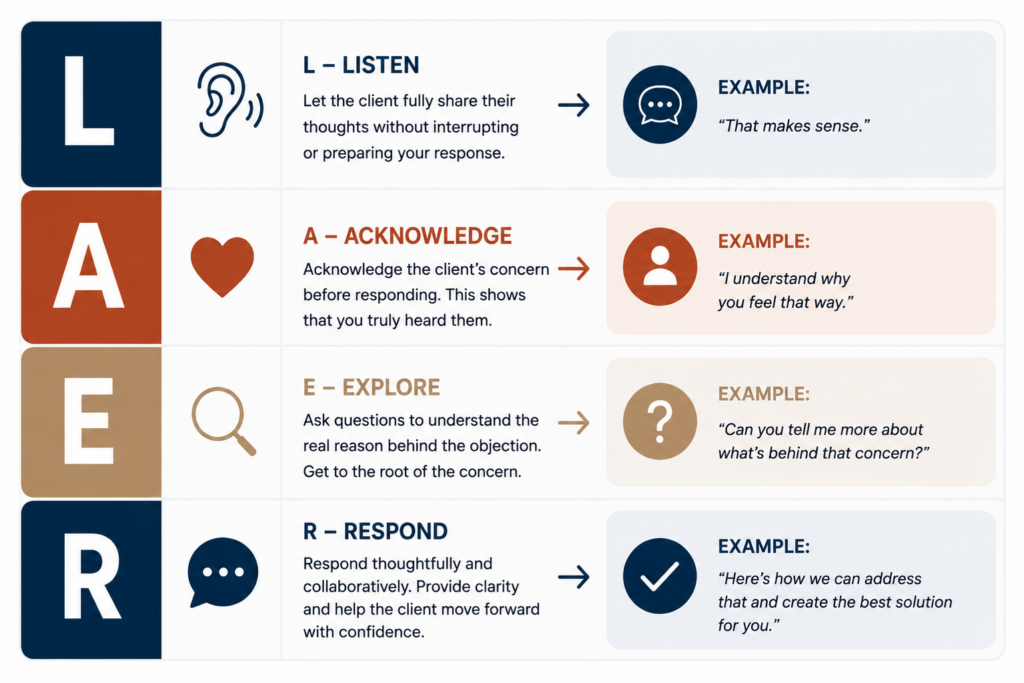
One of the most effective frameworks for handling objections is the LAER method. Its purpose is not to quickly overcome the client’s objection, but to understand what is truly behind it.
LAER stands for:
For more on how listening drives sales results, read our post on the 70/30 rule.
The first step is the hardest: do not interrupt the client and do not immediately start preparing your response. Let the client fully express their thoughts.
If a client says:
“The price feels high,” do not immediately begin explaining value. Very often, the client will add important context after a short pause:
“…compared to our previous provider”
or
“…with the budget we currently have this quarter.”
Acknowledge the client’s concern before responding. This does not mean agreeing with the objection. It simply shows that you genuinely heard and understood them.
For example:
Acknowledging the concern lowers defensiveness and creates space for a more honest conversation.
This is the most important part of the LAER method and also the step many salespeople skip. Instead of immediately trying to overcome the objection, ask questions that help uncover the real issue behind it.
For example:
These questions do not feel manipulative. They help the client better understand and express their own thoughts.

Very often, the real issue is not the price itself, but the perceived value.
Example response: “I understand. Compared to what does the price feel high? Is it compared to another offer or your current budget?”
This often means the client does not yet see enough reason to continue the conversation.
Example response: “Of course. To make sure I send the most relevant information, what is currently your biggest challenge in this area?”
This usually means the issue does not yet feel important enough.
Example response: “I understand. What would need to change for this to feel like the right time?”
This often means that change feels risky.
Example response: “That’s actually a good sign because it shows you already see value in this area. What works well with your current solution and what would you like to improve?”
Even experienced salespeople make the same mistakes repeatedly. One of the most common is reacting too quickly. When a salesperson starts preparing a response while the client is still speaking, it becomes noticeable immediately. Another major mistake is arguing. Phrases such as: “Actually, that’s not true,” feel like an attack to the client, even when the salesperson is technically correct.
Overexplaining is another common issue. A long monologue about value after a simple objection often creates even more resistance.
Modern sales is based much more on psychology and emotional intelligence than on pure persuasion skills. Today, clients read reviews, compare alternatives, and form initial opinions long before speaking with a salesperson.
Daniel Pink, the author of To Sell Is Human, has explained that aggressive persuasion no longer works best in modern sales. Instead, success comes from the ability to understand another person’s perspective. The best sales conversations rarely feel like presentations. They feel like two people trying to figure out together whether a solution genuinely creates value.
Handling objections in sales is not a competition about who can argue more effectively. It is the ability to create an environment where the client feels understood and can make a decision they feel good about even after the purchase.
The LAER method helps slow down the conversation, uncover the real issue, and create more trust. This is where average salespeople separate themselves from truly strong sales professionals. In the long run, the people who win in sales are not those who talk the fastest or close the hardest. The winners are those who create clarity, reduce uncertainty, and help people make decisions they will not regret later.
If you want your sales team to handle objections with more confidence, reduce pressure in sales conversations, and build stronger trust with clients, the LAER method offers a practical and modern framework for doing exactly that.
Contact Southwestern Ventures and let’s discuss how we can help your team improve objection handling, communication skills, and sales performance through practical training and coaching.